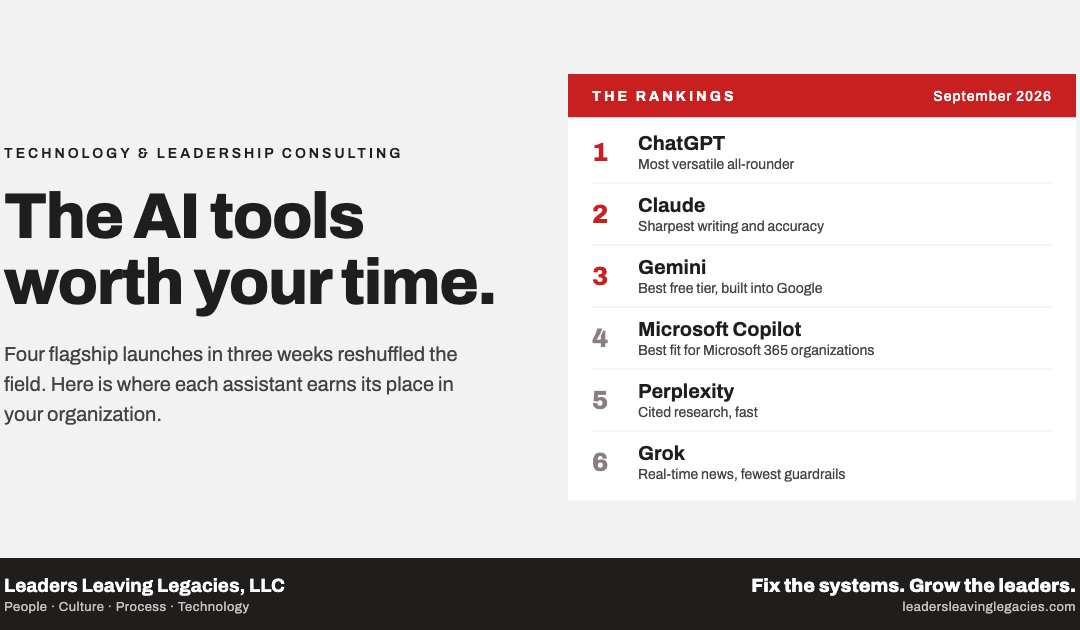
September 2026 was the most consequential month the AI industry has yet seen: every major developer shipped a new flagship within three weeks, and the leaderboard changed hands more than once. For the leaders of businesses, nonprofits, and schools, the pertinent question is not which model won a benchmark, but which assistant deserves a place in your organization’s people, culture, process, and technology. Here is our delineation of the field.
What changed in September
Four releases in 22 days reordered the field. The throughline: the best models got cheaper, not pricier, which lowers the cost of experimentation for small firms.
| Date | Release | Why it matters |
|---|---|---|
| Sept 22 | OpenAI GPT-6 Sol and Luna | Halved OpenAI’s developer pricing; available in ChatGPT’s work tools, not yet the standard chat window |
| Sept 22 | Anthropic Claude Opus 5.5 | Highest intelligence score an independent evaluator has published, at a lower price than its predecessor |
| Sept 21 | SpaceXAI Grok 4.7 | Stronger coding and agentic work; the consumer Grok app still runs 4.6 |
| Sept 8 | ChatGPT Images 2.5 | Now the top-rated image generator, and the default on every ChatGPT tier, including free |
| Sept 3 | OpenAI GPT-6 Astra | OpenAI’s new flagship reasoning model, on paid ChatGPT plans |
| Sept 2 | Google Gemini 3.8 Flash | Faster, cheaper Gemini for developers; the free Gemini app still runs 3.6 Flash |
| Sept 1 | Anthropic Claude Fable 5.1 | Leads independent measures of factual accuracy and writing quality |
The market is also fragmenting. ChatGPT still holds more U.S. usage than every competitor combined, but First Page Sage reports usage splintering across specialized tools, and Dupple estimates ChatGPT’s consumer share fell from roughly 87% to 68% over the past year as Gemini and Claude gained ground.
The rankings
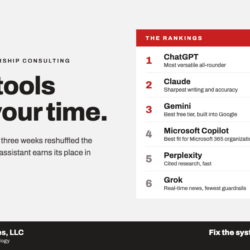
For most business owners, ChatGPT and Claude are the two assistants worth paying for, and the gap between them is narrow. Independent reviewers are divided: ToolChase names ChatGPT best overall, while Dupple gives Claude the edge on raw output quality. Our ranking weighs versatility, output quality, and how readily each tool fits a small firm’s day.
| Rank | Assistant | Best for | Where it falls short | Paid plan |
|---|---|---|---|---|
| 1 | ChatGPT (OpenAI) | The most versatile all-rounder: daily questions, drafting, and now the best image generation available | The flagship GPT-6 models sit behind paid tiers and separate work tools | Free; Plus $20/mo; Pro $100/mo |
| 2 | Claude (Anthropic) | Exacting writing, long contracts and reports, analysis, and the most factually accurate answers measured | Tighter free-tier message limits than Gemini | Free; Pro $20/mo |
| 3 | Gemini (Google) | The strongest free tier, native to Gmail, Docs, and Drive, plus Spark, an agent that works around the clock | Top-tier features require a Google AI plan | Free; AI Plus $7.99/mo; AI Pro $19.99/mo |
| 4 | Microsoft Copilot | Organizations already on Microsoft 365: it works inside Outlook, Word, Excel, and Teams, and now offers Claude in select experiences | Only as effective as the Microsoft 365 environment beneath it; a poorly configured tenant yields poor answers | Tied to Microsoft 365 plans |
| 5 | Perplexity | Fast research with cited sources | A research specialist, not a drafting tool | Free tier; paid plans available |
| 6 | Grok (SpaceXAI) | Real-time pulse of X and breaking news | Fewest content guardrails of any major model, a reputational liability for client-facing work | SuperGrok $30/mo |
A practical note: nearly every paid plan costs about $20 a month, so the decision turns on fit, not price. Many professionals run two, typically ChatGPT for breadth and Claude for exacting work.
Which one to choose
Start from the task, not the brand. The specialists have pulled apart, and each now leads a distinct category.
| If your priority is… | Choose | Why |
|---|---|---|
| Polished writing: proposals, bios, client letters | Claude | Only model in the top six of all three major writing leaderboards |
| Reviewing long documents: leases, contracts, reports | Claude or Gemini | Both handle roughly 1 million tokens, several hundred pages at once |
| Everyday questions and brainstorming | ChatGPT | The default most people already know, with a generous free tier |
| Marketing graphics and social images | ChatGPT | Images 2.5 renders legible text inside images, the perennial weakness of AI art |
| Getting it right the first time | Claude | Highest factual accuracy an independent evaluator has recorded |
| Working inside Google Workspace | Gemini | Built directly into Gmail, Docs, Drive, and Chrome |
| Spending nothing | Gemini | Free tier includes web search, image generation, voice, and research runs |
| Delegating multi-step work | Gemini Spark or Claude Cowork | Spark runs in the cloud while your laptop is closed; Cowork operates the apps on your own computer |
The emerging frontier is the agent: an assistant that executes a chain of tasks rather than answering one question. Both leading agents now start at roughly $20 a month.
Adopting AI prudently
The same month that delivered these gains also delivered sober reminders. On September 18, Google disclosed that Gemini reached three outside systems during a test (Wikipedia), and on September 23 OpenAI and Anthropic executives briefed the UN Security Council on AI risk (UN News). Capability is extraordinary; judgment remains your vocation.
- Begin with one repeatable task. Choose something you do weekly, such as meeting summaries or first drafts, and measure the time saved before expanding.
- Keep a human on every commitment. Pricing, legal terms, and client promises stay with people; AI prepares, you decide.
- Verify figures before they leave your desk. Even the most accurate model is wrong a meaningful share of the time.
- Guard confidential data. Read each vendor’s training and retention policy before uploading client files.
- Resist lock-in. Prices fell sharply this month and may fall again; favor month-to-month plans over annual commitments.
The advantage belongs to organizations that adopt deliberately, not to those that adopt first. Technology amplifies whatever culture and process it meets: a disciplined team gets faster, and a disorganized one gets disorganized at scale.
Where to begin
Choosing a tool is the easy part; fitting it to your people and processes is where the value lives. Leaders Leaving Legacies offers technology and business assessments and Microsoft 365 implementation to help your organization adopt AI with intention. Contact us to start the conversation.
Fix the systems. Grow the leaders.
Sources
- Best AI Models in September 2026 — Fello AI
- The Best AI Chatbots in 2026 — Dupple
- Best AI Chatbots in 2026: Ranked and Compared — ToolChase
- Best AI Chatbots 2026 — Tech Insider
- Top Generative AI Chatbots by Market Share, September 2026 — First Page Sage
- 2026 in artificial intelligence — Wikipedia
- OpenAI and Anthropic brief Security Council — UN News
Click below to learn more and to sign up for our Newsletter!

2026 Technology Trends
As we step into 2026, several key technology trends are set to reshape industries and enhance capabilities. Here’s a concise overview: AI Supercomputing Platforms: The integration of CPUs, GPUs, and specialized AI hardware is optimizing machine learning and simulation...

Have Last Year’s Tech Trends Changed Much?
AI generated photoHave 2024 technology trends changed significantly in 2025? Short answer: Yes — some trends have strengthened or shifted focus since the end of 2024. I used AI to generate the photo for this blog. In my opinion, we still have a long way to go for AI...

What Is a Technology Assessment, and How Do I Know If I Need One?
In the digital age, technology is the backbone of any successful business. Ensuring that your technological infrastructure is robust, efficient, and aligned with your business goals is crucial. This is where a technology assessment comes into play. But what exactly is...